
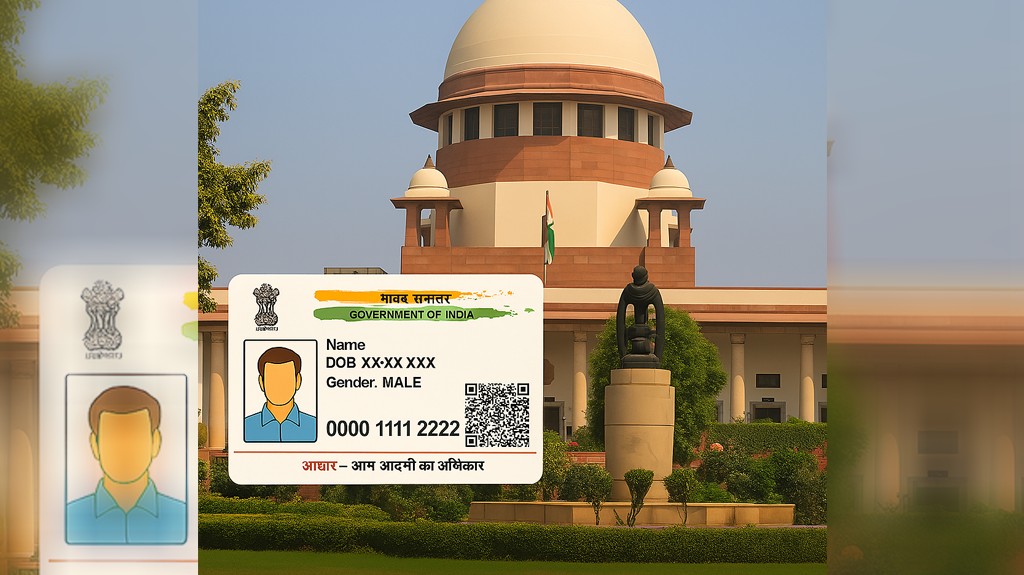
The Election Commission of India (ECI) has reiterated before the Supreme Court that an Aadhaar card does not constitute proof of Indian citizenship, sparking a legal debate and raising concerns over the ongoing Special Intensive Revision (SIR) of electoral rolls in Bihar.
The statement came during a hearing on petitions challenging the legality and timing of the SIR process, particularly its implications on voter eligibility ahead of the 2025 Bihar Assembly elections.
ECI’s Stance: Aadhaar Not Proof of Citizenship
In its submission, the ECI clarified that Aadhaar is not a valid document to prove citizenship, especially for individuals who were not already listed on the 2003 electoral roll. The Commission cited legal limitations and the absence of citizenship validation during Aadhaar issuance.
“Aadhaar is a proof of identity and residence, but not of nationality,” said Senior Advocate Rakesh Dwivedi, appearing on behalf of the ECI.
Legal Challenge by Petitioners
Senior Advocate Gopal Sankaranarayanan, representing the petitioners, argued that the Representation of the People Act does allow for Aadhaar to be linked to voter ID, questioning the ECI’s selective use of the document.
“If Aadhaar is acceptable under the law for de-duplication and linkage, it should not be selectively disregarded when it comes to voter registration,” said Sankaranarayanan.
Supreme Court Raises Concerns
The apex court expressed serious concerns about the timing of the SIR in Bihar. With elections nearing, the Court observed that removing or denying voters based on the 2003 baseline could potentially disenfranchise legitimate voters.
“This process might end up excluding those already on the 2025 rolls,” remarked the bench, calling for a cautious and inclusive approach.
Key Issues at a Glance
| Issue | Details |
|---|---|
| Core Concern | Whether Aadhaar can serve as proof of citizenship |
| ECI’s Position | Aadhaar is not valid for citizenship verification |
| Petitioners’ Argument | Aadhaar’s legal acceptability under Representation of People Act |
| Supreme Court’s Concern | Risk of disenfranchisement close to state elections |
| Impacted Area | Bihar – undergoing Special Intensive Revision (SIR) of electoral rolls |
Background: The 2003 Electoral Roll Benchmark
The 2003 electoral roll is being used as a reference point for verifying voter legitimacy in Bihar’s ongoing voter list revision. This effectively means newer residents or those missing from that baseline must now prove their citizenship through alternative means—excluding Aadhaar.
Looking Ahead
The Supreme Court is expected to continue deliberations in the coming weeks and may issue directions to ensure that no eligible voter is unfairly excluded from the upcoming election. The outcome could set a precedent on the interplay between Aadhaar, citizenship verification, and voter rights in India’s electoral framework.