
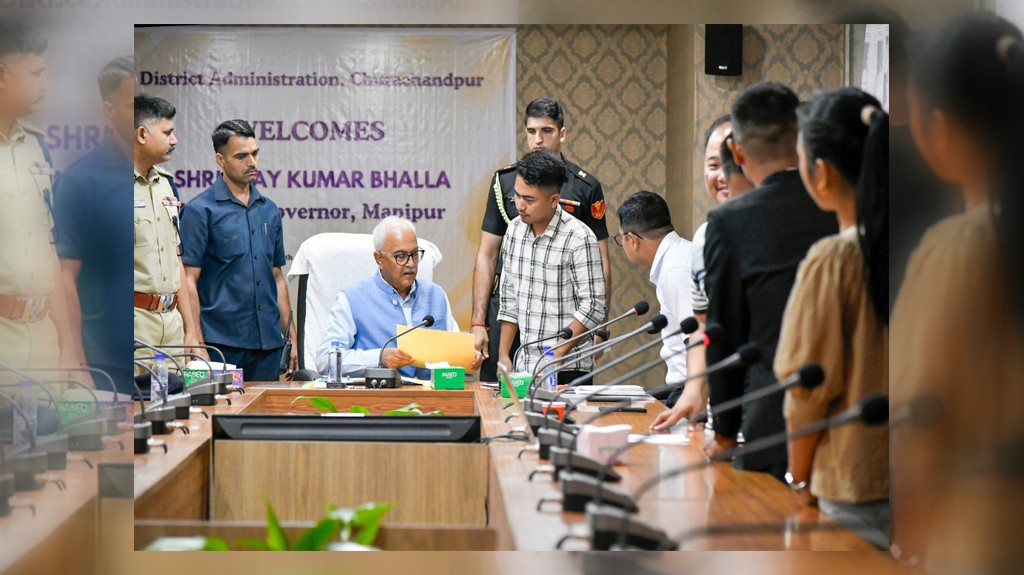
The Hon’ble Governor of Manipur, Shri Ajay Kumar Bhalla, chaired a series of interactive sessions with legislators, civil society organizations, and student leaders at the Deputy Commissioner’s Office, Churachandpur on Wednesday. The meetings were part of ongoing outreach efforts to address pressing concerns from hill districts and strengthen dialogue between communities and the state administration.
Councils Submit Memoranda
During the session, the Kuki-Zo Council (KZC) and the Zomi Council (ZC) submitted detailed memoranda highlighting a wide range of public issues. Key demands centered on:
Education: Upgrading of institutions, adequate staffing, timely release of scholarships, and better infrastructure in remote areas.
Connectivity: Road repairs, new link routes for inter-district access, and improved transport services to reduce isolation of hill districts.
Governance: Posting of neutral officials in sensitive areas, fair representation in administrative structures, and clearance of salary arrears in higher education.
Resettlement of IDPs: Urgent support for internally displaced persons affected by recent conflicts, including livelihood rehabilitation, housing, and access to basic services.
The memoranda emphasized the need for targeted interventions that reflect the unique challenges of Kuki-Zo and Zomi inhabited areas, particularly in the aftermath of prolonged instability.
Governor’s Assurance
Governor Bhalla acknowledged the depth of the concerns raised and assured all participants that their grievances would be addressed with urgency. He stressed the importance of maintaining open channels of communication between civil society, elected representatives, and the state administration.
“The government remains committed to ensuring that voices from every community are heard and acted upon,” the Governor said, adding that both short-term relief and long-term policy solutions were being examined.
Building Trust Through Dialogue
The meeting was also seen as a trust-building exercise. Student leaders welcomed the opportunity to present their perspectives directly, while MLAs called for more frequent forums of engagement between the Raj Bhavan and grassroots stakeholders. Civil society representatives noted that such direct interaction was crucial to bridging the communication gap that often exists in conflict-affected regions.
Way Forward
The Governor’s assurance has been viewed positively, though community leaders emphasized that timely follow-up will be key in restoring public confidence. For many, the resettlement of IDPs and improvement of road connectivity remain the most urgent priorities.
As one participant put it: “Acknowledgment is the first step. What people are waiting for is visible action.”