
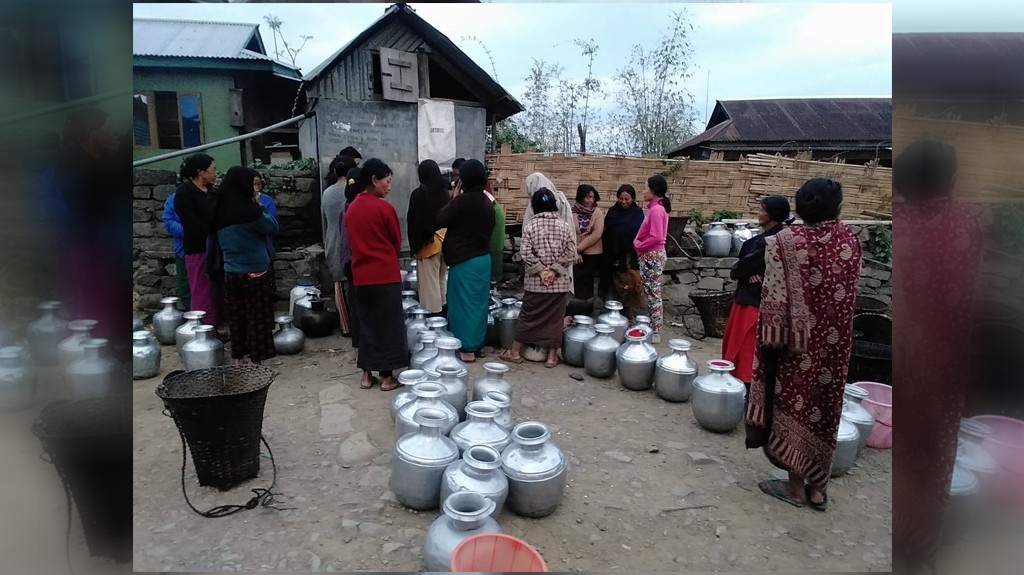
While government data under the Jal Jeevan Mission (JJM) proudly declares that most households in Senapati district now have functional tap water connections, the lived reality of villagers paints a very different picture.
Across several hill villages, residents continue to struggle daily for access to safe and adequate water. The sight of women and children queuing up before dawn to fill buckets from community tanks or public taps remains a routine — and exhausting — part of life.
“We have tap connections, yes — but water rarely comes,” said a resident of Paomata village, her hands clutching two empty containers. “Sometimes it flows for 10 minutes, sometimes not at all. We can’t rely on it.”
Water Connections Without Water Supply
The Jal Jeevan Mission, launched nationally in 2019 with the vision of providing ‘Har Ghar Jal’ (tap water to every household), has achieved impressive numbers on paper. Official records for Senapati district show near-universal coverage. However, site visits and ground-level testimonies reveal erratic or negligible water flow in many homes.
Even during the relatively wetter months, villagers report standing in long queues at community tanks or shared water points. During dry spells, the crisis deepens — forcing families to walk long distances to fetch water from streams or hand pumps.
“My daughters wake up at 3 a.m. to fill two buckets before the supply stops,” shared a father from Tadubi area. “By morning, the taps are dry. The rest of the day, we depend on tankers or wells.”
Students returning from schools and colleges often spend hours fetching water before they can study or rest. In some villages, a single public tank serves dozens of families, making access difficult and uneven.
A Daily Burden, Especially for Women and Children
The continuing water scarcity has taken a visible toll on the social and physical well-being of Senapati’s rural population. Women — traditionally responsible for managing household chores — shoulder the heaviest burden, often trekking uphill with heavy water containers.
Children, too, are affected. Many students lose valuable study time helping their families collect water, while others face health risks from consuming untreated sources when clean water is unavailable.
“People assume that once a tap is installed, the problem is solved,” said a local youth volunteer from the district. “But what’s the use of a tap if no water flows through it?”
Implementation and Monitoring Gaps
Experts and local observers point to several causes behind the gap between reported progress and ground reality — inadequate source development, pipeline leakage, poor maintenance, and lack of regular monitoring.
The JJM mandates not just the installation of tap connections, but also functional water supply, regular testing, and community involvement in maintenance. In Senapati, these aspects appear inconsistent or insufficient.
Several civil society groups have called for a district-level audit of JJM implementation, stressing the need for transparency, accountability, and community participation.
A Call for Genuine Reform
Despite the hardships, villagers express hope that authorities will take corrective action. Many have appealed for sustained water supply rather than symbolic installations.
The issue underscores a broader truth — that development cannot be measured by infrastructure alone, but by the real impact it brings to people’s lives.
Until then, for many in Senapati, the promise of “Har Ghar Jal” remains half-fulfilled — flowing only on paper, not through their taps.