
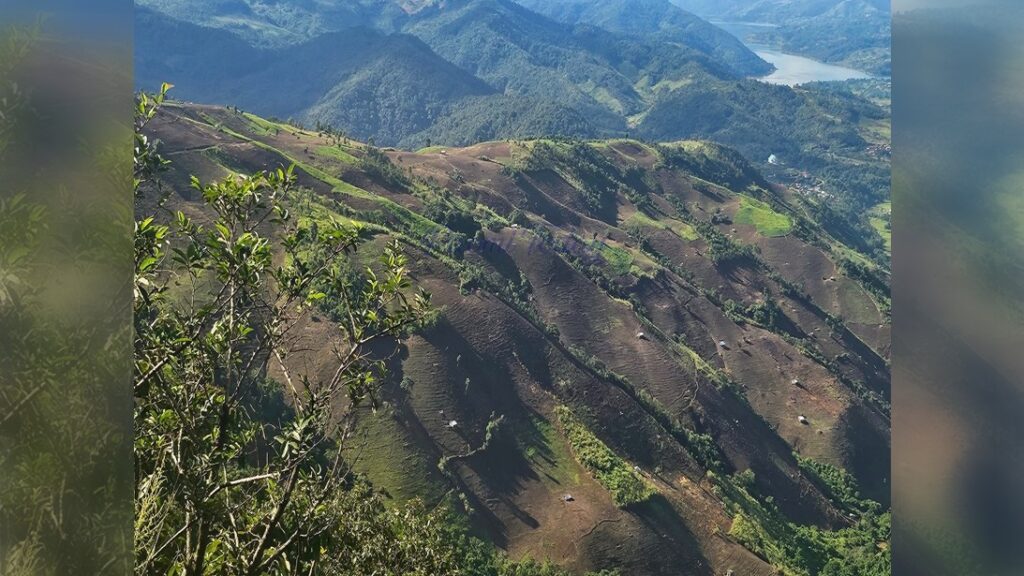
While Manipur’s headlines remain dominated by the prolonged ethnic conflict between the Meitei and Kuki–Zo communities, a quieter, deadlier crisis has been expanding across the hills — one that fuels the very fires it hides behind.
That crisis is poppy cultivation — and its grip on Manipur runs far deeper than most public debates dare acknowledge.
Over the past two years, vast resources, reportedly running into thousands of crores, have been spent by both the state and central governments on managing ethnic violence. Yet, poppy plantations — the economic lifeline of narco-networks and insurgent groups — remain largely untouched.
Despite high-profile “War on Drugs” drives, field data and satellite imagery suggest widespread regrowth in forested areas, raising questions about political will and enforcement capacity. Neither the state nor New Delhi has taken sustained, verifiable action to eradicate these fields, allowing a parallel economy to thrive — one that funds militancy, arms smuggling, and even demographic shifts through illegal migration and land encroachment.
The uncomfortable truth is this: poppy is not just a crop; it’s the bloodstream of Manipur’s shadow war.
A Look at Parliamentary Voices
Interestingly, only a few of Manipur’s representatives in Parliament have addressed this head-on — and even fewer have managed to sustain attention beyond symbolic remarks.
1. Dr. Angomcha Bimol Akoijam (Congress, Inner Manipur)
Among the three MPs, Dr. Bimol Akoijam has been the most vocal.
On December 16, 2024, he posed a starred question in the Lok Sabha to the Minister of Environment, Forest, and Climate Change, demanding district-wise data on forest areas affected by poppy cultivation and the measures taken to combat it.
Akoijam’s reasoning stems from an environmental and security lens — highlighting how poppy encroaches upon protected forests, leading to deforestation, soil degradation, and the spread of illicit activities.
Outside Parliament, he has used his public platform to speak more symbolically. In a December 2023 X post, he wrote about being “high on love for Manipur,” a veiled jab at the drug-driven forces corroding the state’s social fabric. His approach blends environmental urgency with a moral critique — casting poppy as both an ecological and ethical threat to Manipur’s survival.
2. Maharaja Leishemba Sanajaoba (BJP, Rajya Sabha)
Maharaja Sanajaoba has largely championed anti-poppy efforts through public messaging rather than legislative action.
In January 2025, he praised Chief Minister N. Biren Singh’s destruction drives, calling them steps toward a “Poppy-Free Manipur.” In subsequent posts, he tied the issue directly to border security and illegal immigration, arguing that the narcotics economy fuels insurgency and weakens national integrity.
His reasoning fits a nationalist framework — emphasizing border fencing, deportation of undocumented immigrants, and cross-border surveillance as central to dismantling the drug trade. While his interventions have been public rather than parliamentary, they reinforce a state-level narrative that sees poppy not as an agricultural problem but a strategic threat to India’s sovereignty.
3. Alfred Kanngam S. Arthur (Congress, Outer Manipur)
Alfred Kanngam Arthur, representing Manipur’s hill constituencies — the very regions where poppy cultivation thrives — has not made any direct statements or parliamentary interventions on the issue to date. His silence contrasts sharply with the visible stakes in the outer districts, where entire slopes of protected forests have been cleared for poppy plantations.
A Crisis Hiding in Plain Sight
If left unchecked, the poppy economy could reshape Manipur’s demographics, ecology, and governance for generations.
Beyond funding insurgent activity, it erodes legitimate agriculture, displaces local communities, and traps youth in cycles of addiction and criminality.
While Meitei and Kuki leaders trade accusations and the government counts security deployments, the poppy fields continue to expand — quietly underwriting both sides of the conflict.
The tragedy is that the war over identity may end, but the war over narcotics has only begun.