
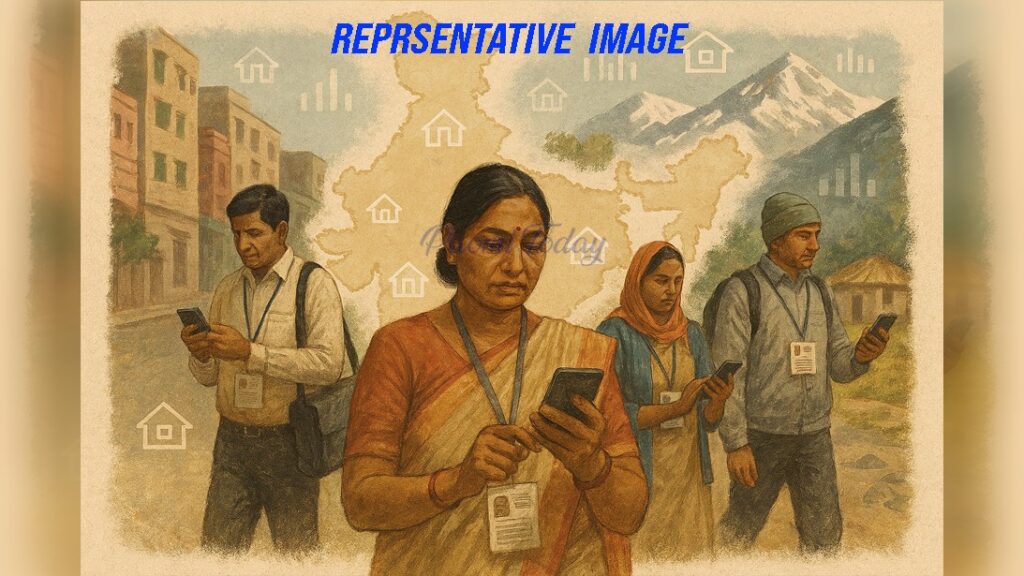
After a prolonged gap, India’s decennial census is officially back on the calendar. The Union Cabinet on Thursday approved the conduct of Census of India 2027, allocating ₹11,718 crore for what will be the country’s first fully digital census exercise.
The decision was taken at a Cabinet meeting chaired by Prime Minister Narendra Modi, with Information and Broadcasting Minister Ashwini Vaishnaw later outlining the scale and scope of the exercise.
Two Phases, One Digital Backbone
According to the Cabinet approval, Census 2027 will be conducted in two distinct phases:
| Phase | Timeline | Scope |
|---|---|---|
| House-listing & Housing Census | April–September 2026 | Housing conditions, assets, amenities |
| Population Enumeration (PE) | February 2027 | Individual demographic details |
For Ladakh and other snow-bound, non-synchronous areas of Jammu & Kashmir, Himachal Pradesh, and Uttarakhand, the population enumeration will be conducted earlier, in September 2026, to account for climatic constraints.
Caste Data to Be Captured Digitally
In a significant policy move, the government confirmed that caste data will be collected electronically during the Population Enumeration phase.
While caste information has historically been a sensitive and politically charged subject, the Centre emphasised that digitisation will improve accuracy, reduce duplication, and minimise manual errors.
30 Lakh Field Workers, One Mobile App
The scale of the operation remains massive. Around 30 lakh enumerators and supervisors will be deployed across the country to carry out the exercise.
For the first time:
A mobile application will be used for on-ground data collection
A central monitoring portal will track progress in real time
Built-in validation checks will reduce inconsistencies
According to Vaishnaw, this shift will ensure higher data quality, faster processing, and stronger accountability at every level.
Census-as-a-Service: Data on Demand
Perhaps the most transformative aspect of Census 2027 is how the data will be used after collection.
The government plans to roll out Census-as-a-Service (CaaS) — a system where ministries and departments can access census data in:
Clean
Machine-readable
Actionable formats
Instead of waiting years for bulky reports, policymakers will be able to retrieve datasets with a click, tailored to specific parameters such as health, education, housing, migration, or employment.
“This will significantly improve data dissemination and evidence-based policymaking,” Vaishnaw said.
Why Census 2027 Matters
India’s last full census was conducted in 2011. The 2021 exercise was postponed due to the COVID-19 pandemic, creating a data vacuum during a period of rapid demographic, economic, and social change.
Census 2027 will:
Reset the baseline for welfare schemes
Inform delimitation and representation
Shape urban planning and infrastructure investment
Influence fiscal transfers and development priorities
In short, it will quietly determine how resources, power, and policy are distributed over the next decade.
A Logistical Challenge — and a Digital Test
While the Cabinet’s approval clears the path, the real test lies ahead: training millions of field workers, ensuring digital access in remote regions, protecting data privacy, and maintaining public trust.
The success of Census 2027 won’t be judged on announcements — but on execution.