
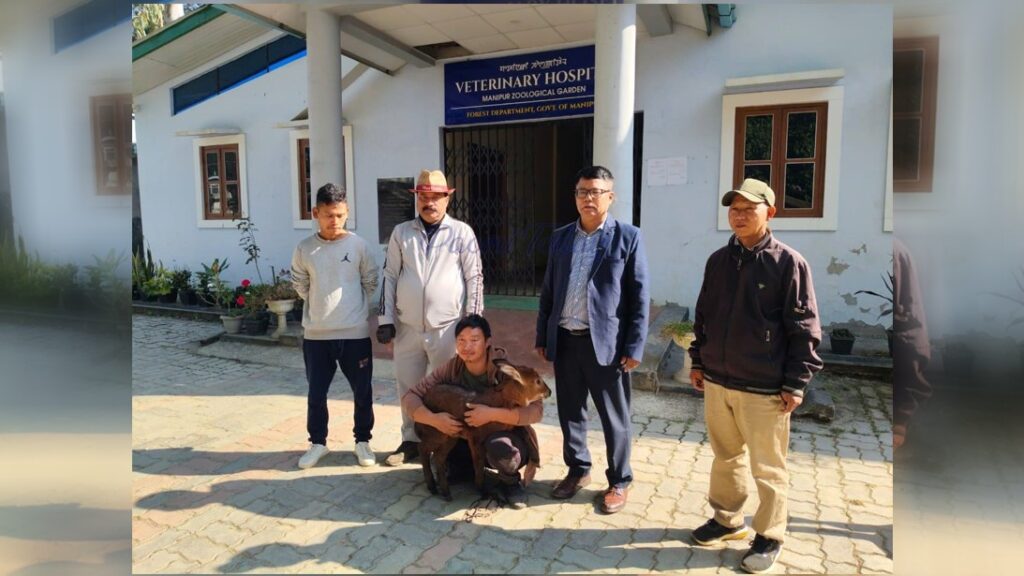
In a heartening example of community participation in wildlife conservation, a fawn of the endangered Serow was successfully rescued in Tamenglong district and formally handed over to the Manipur Zoological Garden for medical care and rehabilitation on Friday morning.
The rescued animal, locally known as Sabeng, bears the scientific name Capricornis rubidus. The species is listed under Schedule I of the Wildlife (Protection) Act, 1972, granting it the highest level of legal protection in India. It is also classified as “Vulnerable” on the International Union for Conservation of Nature (IUCN) Red List.
Rescue by a Local Youth
The serow fawn was rescued on November 26, 2025, by Keijuilung Pame, son of Arum Pame, a resident of Impa village under Tousem Sub-division in Tamenglong district. According to forest officials, the young animal was found separated from its natural habitat under circumstances that would have made its survival in the wild uncertain.
Instead of attempting to keep the animal or leaving it vulnerable to predators, Pame promptly informed the Forest Department and ensured the fawn’s safe custody.
On November 27, the rescued serow was formally handed over to Shri A. Promeshwor Singh, Range Forest Officer (RFO) of Tousem, initiating the official wildlife rescue and documentation process.
Safe Transfer to Imphal Zoo
The following morning, at around 9:30 a.m. on November 28, the serow fawn was transported under official supervision and handed over to the veterinary authorities of the Manipur Zoological Garden. The transfer was carried out by the Tamenglong Forest Division, led by Divisional Forest Officer Kharibam Hitler Singh, along with staff from the Tousem Range.
The fawn was received by Dr. L. Saratchandra Singh, Veterinary Officer of the zoo, who confirmed that the animal would undergo detailed medical evaluation, nourishment support and observation before any decision is taken regarding long-term rehabilitation.
Importance of the Serow in Manipur’s Ecosystem
The serow is a rare mountain-dwelling ungulate found in the forested hills of Northeast India. Shy and largely nocturnal, it is seldom seen in open areas. Habitat loss, hunting pressure and human encroachment continue to threaten its survival across its natural range.
Forest officials stressed that the rescue of a serow fawn is particularly significant because juveniles rarely survive without their mother in the wild unless timely human intervention takes place. The current rescue is therefore considered a vital contribution to species protection.
Appreciation for Responsible Citizen Action
The Forest Department has appreciated the responsible conduct of the rescuer, noting that public awareness and cooperation remain the backbone of wildlife conservation in remote hill regions.
Officials reiterated that wild animals found injured, abandoned or disoriented should never be kept as pets or handled without informing authorities, as such actions can endanger both human life and protected species.
The rescued serow fawn is now under constant veterinary care at the Manipur Zoological Garden, with officials hopeful that it will regain strength in a safe and controlled environment.