
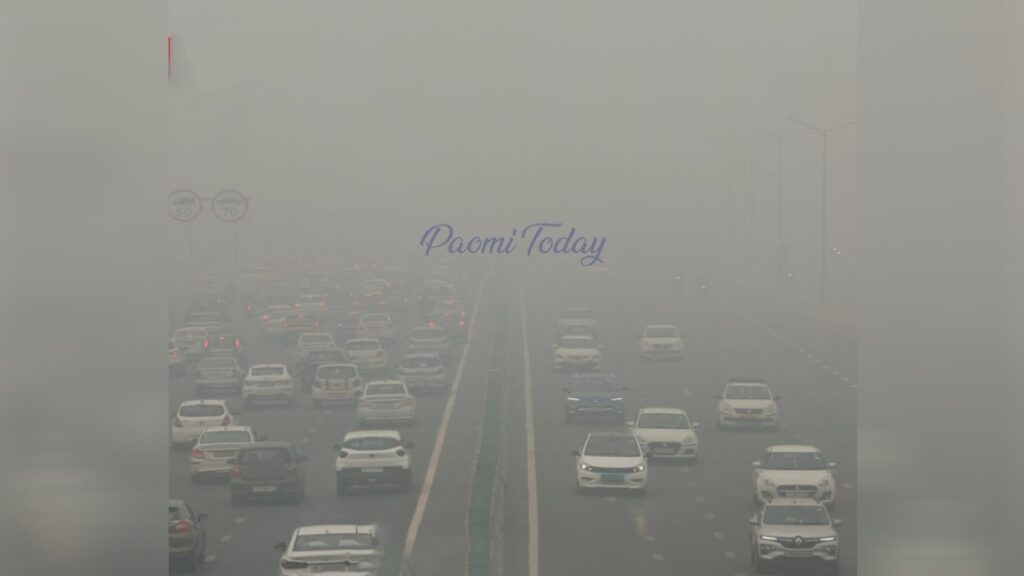
Delhi woke up to another morning wrapped in thick, choking haze as the city’s air quality continued to deteriorate following Diwali celebrations. According to real-time data from the Central Pollution Control Board (CPCB), the capital’s average Air Quality Index (AQI) stood at 334 at 11:06 am, categorised as “very poor”.
The blanket of smog that descended on the city after the festival’s night-long fireworks showed no signs of lifting, forcing residents to endure burning eyes, sore throats, and difficulty in breathing. The worst-hit pocket was Punjabi Bagh, where the AQI spiked to 411, pushing it into the “severe” category.
What the numbers say
| Area | AQI Reading | Category |
|---|---|---|
| Punjabi Bagh | 411 | Severe |
| Anand Vihar | 389 | Very Poor |
| RK Puram | 348 | Very Poor |
| Mandir Marg | 325 | Very Poor |
| Lodhi Road | 308 | Very Poor |
(Source: CPCB Sameer App, 11:06 am update)
Officials said that apart from the heavy use of firecrackers, a combination of low wind speed, temperature inversion, and ongoing stubble burning in nearby states contributed to the pollution spike.
Health risks mount
Doctors have advised vulnerable groups — including children, the elderly, and people with respiratory conditions — to avoid outdoor exposure.
Dr. Poonam Arora, a pulmonologist at Safdarjung Hospital, warned:
“The fine particulate matter, especially PM2.5, has breached safe limits many times over. Even short exposure can trigger asthma, eye irritation, and cardiovascular stress.”
The Delhi government has urged residents to limit outdoor activities and use N95 masks when stepping outside. Emergency measures such as restrictions on construction activities and vehicle checks are expected to be enforced under GRAP Stage III if conditions persist.
The bigger picture
The pattern repeats almost every year: a festival of lights followed by a week of toxic air. Despite awareness campaigns and cracker bans, fireworks continued across several neighbourhoods. Environmentalists argue that enforcement remains weak and that systemic interventions — like cleaner transport and agricultural reforms — are essential for lasting change.
Meanwhile, satellite imagery shows a surge in farm fires across Punjab and Haryana. Experts note that unless coordinated regional action is taken, Delhi’s pollution crisis will remain seasonal but deadly.
In short
The celebration is over, but the consequences linger in the air — quite literally. For Delhi’s residents, each breath this week comes with a warning label.