
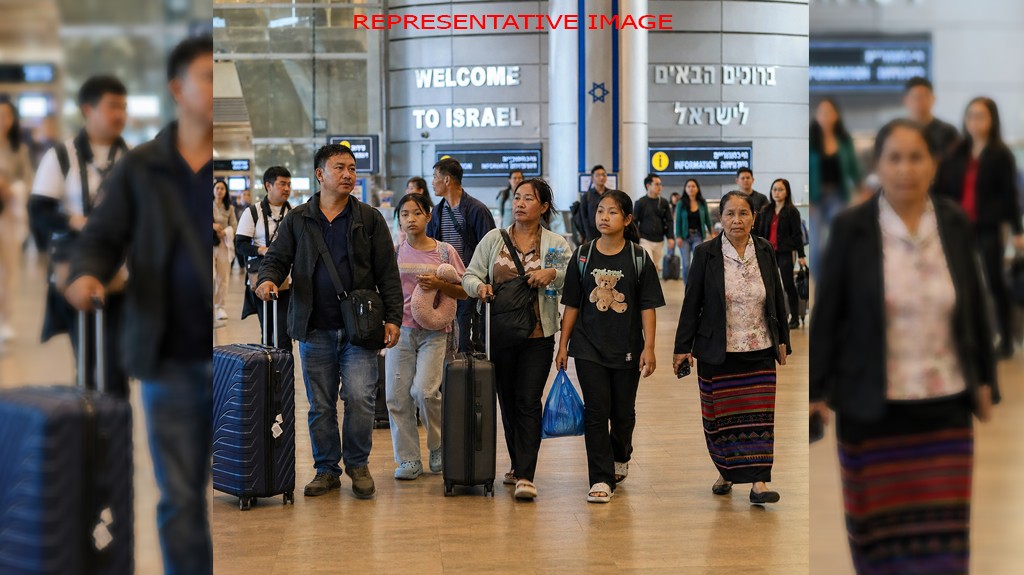
A new group of the Bnei Menashe community from India’s Northeast has arrived in Israel, marking another step in a long-running migration rooted in faith, identity, and historical belief.
On Thursday, around 240 members of the Bnei Menashe community landed at Ben Gurion Airport as new immigrants, or Olim, according to reports from Israel-based agencies. The group was flown from New Delhi as part of a coordinated effort led by the Ministry of Aliyah and Absorption and the Jewish Agency for Israel.
Many among the arrivals were young families. They are expected to stay initially in government-supported absorption centres in Nof HaGalil, where they will begin the process of settling into Israeli society. For several, the move also brings reunions with relatives who migrated in earlier phases.
A Migration That Spans Decades
The latest arrival builds on a process that has been unfolding for over two decades. Around 4,000 members of the Bnei Menashe community have already migrated to Israel under earlier government decisions.
The current phase falls under Operation “Wings of Dawn,” a programme aimed at facilitating the relocation of thousands more individuals from the community. Under this initiative, approximately 1,200 additional members are expected to arrive by the end of 2026.
Looking further ahead, Israeli authorities plan to bring nearly 4,800 more individuals from Manipur and Mizoram by 2030. In total, about 6,000 Bnei Menashe are projected to complete their migration under the current plan.
Identity, Belief, and Historical Roots
The Bnei Menashe—often referred to as the “Children of Menashe”—trace their lineage to the Biblical figure Menashe, the eldest son of Joseph. They are also known locally as Shinlung in parts of Northeast India.
Scholars and community narratives suggest that their ancestors may have been among groups dispersed from ancient Israel more than 2,500 years ago. Over generations, they are believed to have migrated across regions including Central Asia, China, Tibet, and Southeast Asia before settling in present-day India and Myanmar.
Today, members of the Bnei Menashe community are largely drawn from Kuki, Chin, and Mizo tribal groups. They speak Tibeto-Burman languages but maintain religious and cultural practices aligned with Judaism, which has played a central role in shaping their identity.
The Role of Organisations and Advocacy
Efforts to facilitate the community’s migration have been supported by various organisations, including those focused on documenting and preserving lesser-known Jewish histories. Among them is the Scattered Among the Nations, which works to highlight the diversity of Jewish communities worldwide and support those in geographically isolated regions.
Such organisations have contributed to awareness-building, cultural preservation, and logistical support for communities seeking to reconnect with Jewish heritage.
A Transition Beyond Geography
For the families arriving this week, the move represents more than relocation. It involves adapting to a new language, economy, and social structure, while also integrating into a society shaped by its own complex history.
The absorption process typically includes Hebrew language training, housing assistance, and employment support—tools intended to ease the transition while maintaining continuity with cultural identity.
As more groups prepare to make the journey in the coming years, the Bnei Menashe Aliyah remains one of the most distinctive migration stories connecting Northeast India to Israel—one shaped as much by belief and memory as by policy and planning.