
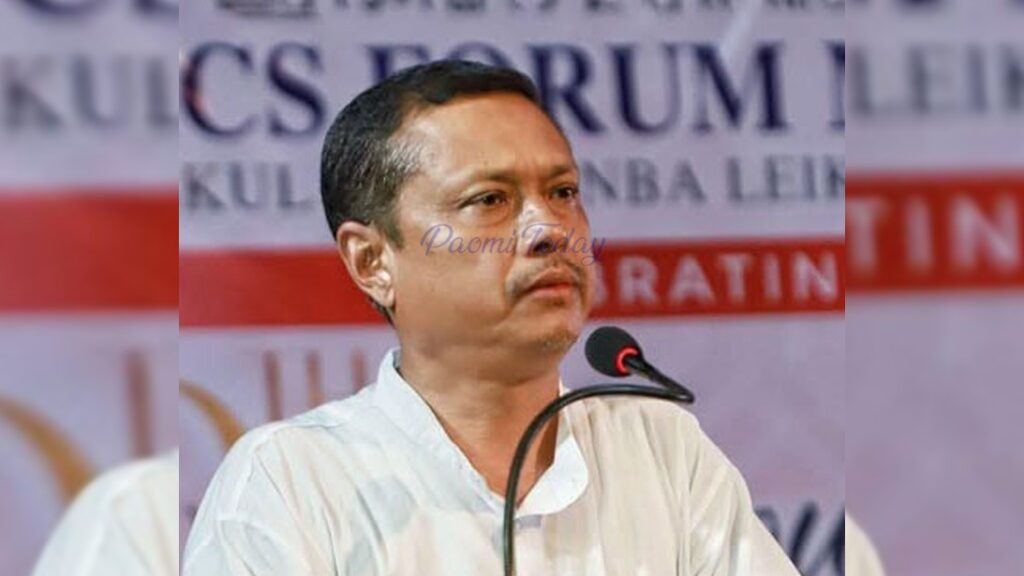
Reiterating a long-standing cultural and political demand, Rajya Sabha Member of Parliament and Manipur’s titular king Leishemba Sanajaoba on Monday urged the Union Government to grant official recognition to Sanamahi as a separate religion in the national census by introducing a distinct religion code.
Raising the matter during the ongoing session of the Rajya Sabha, Sanajaoba asserted that Sanamahi is among the oldest indigenous religions of the Northeast, with its own complete structure of worship, rituals, sacred traditions and philosophical worldview. He said continuing to list Sanamahi followers under the “Others/ORP” category in census records amounts to systematic misrepresentation and cultural dilution.
“A Living Faith, Not a Sub-Category”
Sanajaoba told the House that Sanamahi is not a sub-sect or derivative belief but a living indigenous religion deeply rooted in the civilisation of the Meitei people. “Clubbing Sanamahi under vague census categories erases a vital identity that has survived for centuries,” he said, calling the existing classification unjust and insensitive to indigenous traditions.
He emphasised that census data is not merely a statistical exercise, but a powerful tool that shapes policy, representation, and cultural protection. Without a separate code, he warned, Sanamahi followers remain demographically invisible in national records.
Protection of Heritage and Constitutional Rights
The MP argued that a distinct census code is essential to safeguard:
-
Cultural heritage and religious practices
-
Demographic visibility of Sanamahi followers
-
Constitutional rights related to identity and freedom of religion
He pointed out that indigenous cultures across the Northeast are already under pressure due to modernisation, migration, and cultural homogenisation. In such a climate, he said, official recognition becomes a crucial shield for survival.
Sanajaoba’s intervention comes at a time when preparations are underway for the next nationwide census, making the question of classification particularly urgent.
Backed by State-Level Resolutions
The renewed demand finds strong backing within Manipur itself. Sanajaoba reminded the House that the Manipur Legislative Assembly has, in the past, passed resolutions seeking a separate and dignified place for Sanamahi in national demographic records.
In addition, several socio-religious organisations and community bodies have stepped up campaigns in recent years, arguing that the absence of a religion code has led to long-term statistical invisibility and policy neglect.
Wider Implications for Indigenous Religions
Policy observers note that Sanajaoba’s appeal has implications beyond Manipur. It feeds into a larger national conversation on how indigenous and nature-based religions across India are represented in official data.
Several indigenous communities in different parts of the country face similar challenges where their faith traditions are either grouped under broad umbrella categories or not distinctly recognised in census documentation.
With the Union Government expected to finalise census frameworks in the coming months, Sanajaoba’s appeal is likely to intensify parliamentary and public debate on the status of indigenous religions.
Awaiting a Policy Response
While no immediate response was recorded in the House, officials indicated that the matter would be examined by the concerned ministries during census preparation exercises.
For now, Sanajaoba’s intervention has once again placed the Sanamahi religion at the centre of national policy discussion, reviving a demand that carries deep cultural, political and emotive significance for a large section of Manipur’s population.