
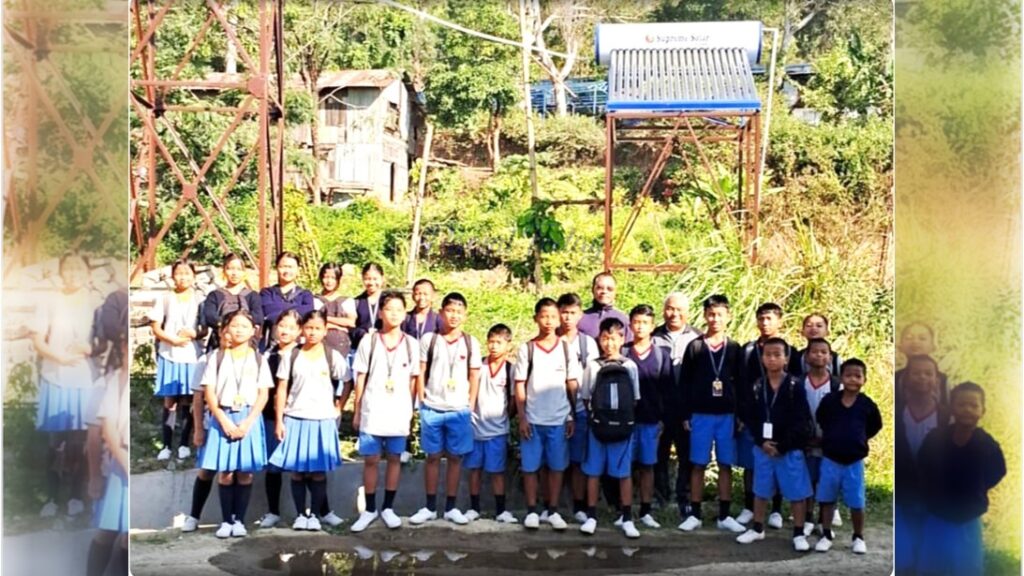
In a move aimed at strengthening clean energy adoption and reducing dependence on conventional power sources, the Department of Science & Technology (DST), Government of Manipur, has successfully installed eight Solar Water Heater systems across educational and residential institutions under the State Level Integrated Rural Energy Programme (IREP).
Each system, with a capacity of 200 litres per day (LPD) supported by 1,000-litre storage tanks, has been strategically installed in government residential schools, community hostels, and college or university hostels across multiple districts. Officials said the initiative demonstrates how renewable energy solutions can be integrated into everyday public infrastructure while delivering long-term economic and environmental benefits.
Clean Energy in Everyday Institutions
The beneficiary institutions span eight districts, reflecting the State’s effort to ensure equitable access to sustainable energy solutions. The installations have been completed at:
| District | Institution |
|---|---|
| Imphal East | Kasturba Gandhi Balika Vidyalaya, Andro |
| Bishnupur | NSCBAV Hostel, Konjeng Junior High School, Moirang Patlou Leikai |
| Imphal West | Netaji Subash Chandra Bose Awasiya Vidyalaya, Lamboikhongnangkhong |
| Chandel | Model Residential School, Mantri Pantha Village |
| Ukhrul | Ukhrul Higher Secondary School, Wino Bazar |
| Senapati | Lungnila Elizabeth College, Senapati Headquarters |
| Imphal East | Working Women-cum-Girls Hostel, Dewlaland |
| Churachandpur | Angels’ Place, Bungmual |
Officials said these institutions were selected based on daily hot-water demand, public utility value, and the potential for demonstration impact within local communities.
Practical Impact Beyond Power Savings
Beyond reducing electricity consumption, the solar water heaters are expected to significantly lower operational costs for hostels and residential institutions. For students, staff, and residents, the systems ensure reliable access to hot water, particularly during colder months, without the recurring expense of electricity or fossil fuels.
A DST official noted that installations in schools and hostels also serve an educational purpose. “When students see renewable energy being used in their own campus, sustainability stops being an abstract concept and becomes a lived experience,” the official said.
Promoting Energy Awareness and Sustainability
The project aligns with Manipur’s broader vision of promoting energy efficiency, climate resilience, and decentralised renewable solutions, particularly in institutions that serve women, children, and youth.
Under IREP, the focus is not limited to infrastructure alone but also includes public awareness and behavioural change. By integrating renewable technology into daily routines, the programme aims to foster a culture of energy responsibility and environmental stewardship.
A Scalable Model for the Future
Officials indicated that the successful deployment of these eight systems could pave the way for wider adoption of solar thermal technology in government buildings, health facilities, and community institutions across the State.
As energy demands grow and power costs rise, such decentralised renewable solutions are increasingly viewed as practical, scalable, and cost-effective alternatives—especially for institutions operating on fixed budgets.
Looking Ahead
With the installation completed, DST Manipur plans to monitor system performance and usage patterns to assess long-term impact. Feedback from beneficiary institutions will guide future expansions under IREP and related renewable energy initiatives.
For Manipur, the project represents more than a technological upgrade—it signals a measured shift toward sustainable development, where clean energy solutions directly support education, welfare, and community resilience.