
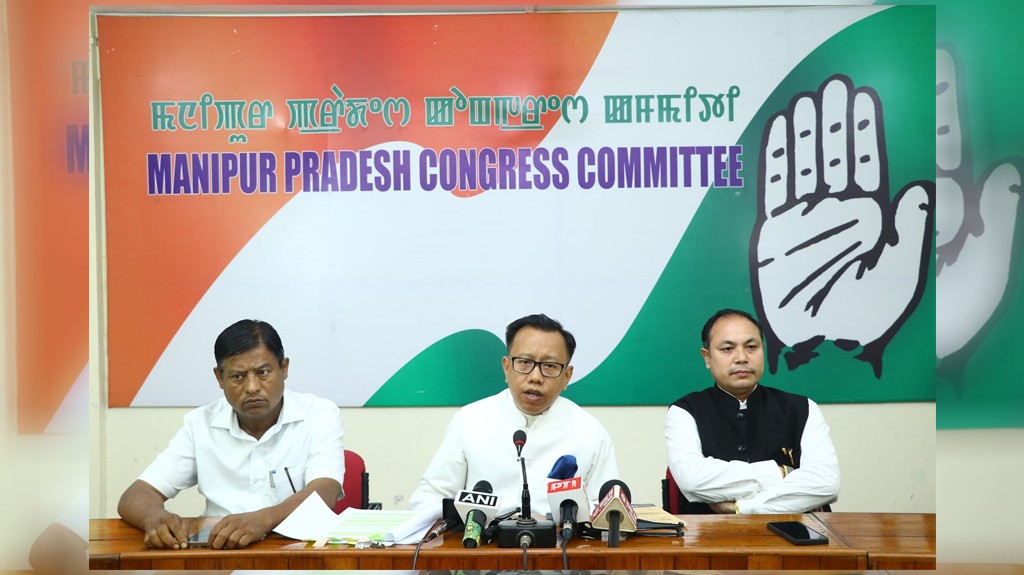
The Manipur Pradesh Congress Committee (PCC) on Saturday commemorated the 20th anniversary of the Right to Information (RTI) Act, 2005, with a press conference held at Congress Bhavan, Imphal, underscoring the law’s enduring role in strengthening democracy and empowering citizens to hold governments accountable.
The event was led by Shri N. Bupenda Meitei, Executive Member, Department of Law, Human Rights & RTI, AICC, and Senior Spokesperson of the Manipur PCC, along with Shri Wahidur Rahman, General Secretary (Organisation & Media), and Advocate Y. Zakir Hussain, Spokesperson, Manipur PCC.
“RTI is the People’s Law” — Congress Leader Bupenda Meitei
Addressing the media, Shri N. Bupenda Meitei described the Right to Information Act as one of the most transformative legislations of independent India, born under the UPA Government led by Dr. Manmohan Singh and guided by the visionary leadership of Smt. Sonia Gandhi.
“The RTI Act remains the strongest democratic tool in the hands of ordinary citizens — empowering them to seek truth, expose corruption, and ensure transparency in governance,” Meitei said.
He reminded that the law, which came into force on 12th October 2005, was not merely a policy reform but a philosophical shift in the relationship between the citizen and the state.
“Before 2005, citizens had to plead for information. After RTI, the government became answerable — the power dynamic changed,” he said, crediting the Congress for championing transparency as a fundamental right.
Congress Reaffirms Commitment to Transparency and Accountability
Highlighting the ongoing challenges to transparency in public institutions, Meitei expressed concern over what he termed the “systematic weakening” of the RTI mechanism in recent years, pointing to vacancies in Information Commissions and delays in responses to public queries.
“RTI is not just a law on paper; it’s the lifeline of democracy. Diluting or neglecting it is equivalent to weakening the voice of the people,” he cautioned.
He urged both the central and state governments to ensure timely appointments of Information Commissioners, maintain digital transparency through public disclosure portals, and safeguard whistleblowers who expose corruption.
A Legacy of the UPA Government
The press conference also recalled the vision of the UPA Government, which introduced landmark legislations such as the RTI Act (2005), the MNREGA, and the National Food Security Act, placing citizen welfare and accountability at the heart of governance.
“The RTI Act was conceived not as a political agenda but as a moral responsibility — to build a government that serves its people with honesty and openness,” Meitei said.
Shri Wahidur Rahman and Adv. Y. Zakir Hussain echoed similar sentiments, reaffirming the Congress’s commitment to protecting democratic institutions and empowering citizens through legal and policy mechanisms.
Looking Ahead: Protecting the Spirit of RTI
Concluding the press conference, the speakers called upon civil society, media, and youth to actively use the RTI Act as a citizen empowerment tool.
“Democracy thrives when information flows freely. The right to know is the right to live with dignity and awareness,” Meitei said.
The event concluded with a symbolic reaffirmation of the Congress’s long-standing pledge to uphold transparency, accountability, and the people’s right to information — principles that continue to define India’s democratic framework two decades after the law’s enactment.