
The demolition of the historic Red Land building in Shillong — where Maharajah Bodhachandra Singh signed the Merger Agreement with the Union of India on September 21, 1949 — has triggered widespread outrage in Manipur, with political leaders and historians calling it a “grave act of cultural erasure.”
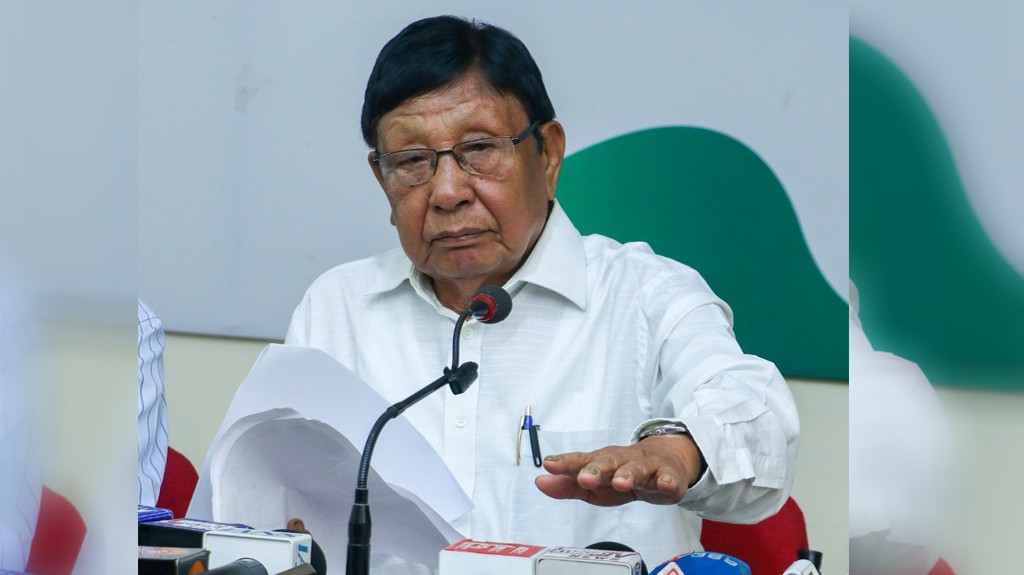
Former Law Minister Okram Joy Singh has strongly condemned the incident, describing it as a “shocking and deliberate attempt to erase a vital chapter of Manipur’s political history.”
Speaking to reporters at his Kakwa residence, O. Joy said the destruction of Red Land represented “a betrayal of collective memory and a disregard for heritage that shaped Manipur’s modern identity.”
“A Targeted Attack on Our History”
Okram Joy, who played a pivotal role in recovering the property for the Manipur government in the early 1990s, recounted the building’s turbulent history.
Originally sold in the early 1980s for a meagre ₹2 lakh, the site was later reacquired by the Government of Manipur through sustained efforts led by O. Joy — then serving as Law Minister — in collaboration with the Department of Arts and Culture and legal experts.
He recalled how, in 1990, the team persuaded then Meghalaya Chief Minister B.B. Lyngdoh to return the property to Manipur, with support from then Chief Minister late Rishang Keishing, who had deposited ₹10 lakh to initiate the process of transfer and restoration.
“We brought Red Land back into Manipur’s hands because it was more than a building — it was a piece of history,” Joy said. “To see it destroyed now, after years of neglect, is heartbreaking and unforgivable.”
He alleged that the demolition was not an accident but a deliberate act, adding, “There is no legal or moral justification for destroying a structure of such political and historical importance. It is a targeted attempt to erase our state’s political glory.”
Ignored Warnings and Failed Appeals
According to O. Joy, multiple appeals were made in recent years to save Red Land from decay and demolition. He cited representations made to the Governor of Manipur, and memoranda submitted by former Union Minister Dr. R.K. Ranjan Singh and Munish Nigthoujam, President of the Manipuri Sahitya Parishad, Meghalaya.
Despite repeated requests, no preservation action was taken. The building — a relic of the post-merger transition that shaped Manipur’s political future — was demolished on September 8, 2025, reportedly without formal consultation or permission from Manipur authorities.
“From 1990 to 2021, no meaningful restoration or renovation was ever attempted,” Joy lamented. “The neglect was criminal; the demolition, catastrophic.”
Demands for Investigation and Accountability
The incident has sparked anger among Manipur’s civil society groups, academics, and political observers, who have urged the government to initiate a high-level inquiry into how the demolition occurred and whether procedural violations took place.
O. Joy has called for the identification and punishment of those responsible, warning that continued inaction could embolden similar disregard for Manipur’s heritage assets.
“Every historic site lost is a page torn from our collective story,” he said. “Red Land’s demolition is a wake-up call. If we don’t act now, we risk losing more than just monuments — we lose our identity.”
A Call to Preserve Manipur’s Heritage
The destruction of Red Land — once a silent witness to Manipur’s integration into the Indian Union — has reignited the broader debate on heritage protection and state accountability.
Historians have described the event as a “cultural tragedy”, underscoring the lack of coordinated heritage policy between the northeastern states. Activists and scholars are now demanding that the remaining historical sites linked to Manipur’s political history be catalogued, restored, and legally protected under state and central heritage laws.
As outrage spreads, Red Land’s ruins stand as a stark reminder of how easily history can be forgotten — and how urgently Manipur’s heritage needs protection before more of its past is lost to neglect and indifference.