
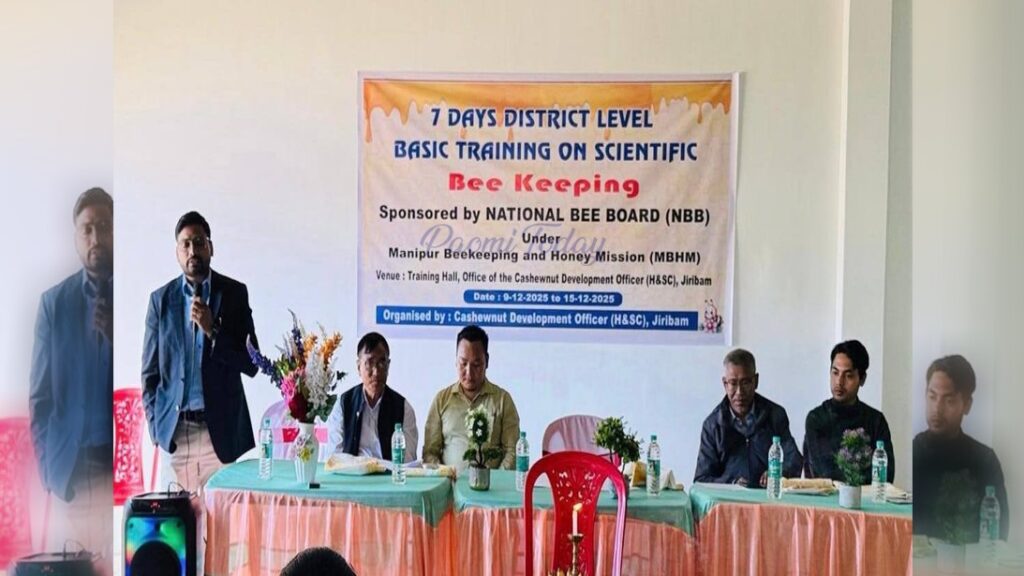
In a step toward expanding sustainable livelihood opportunities, the Department of Horticulture & Soil Conservation (H&SC), Jiribam, in collaboration with the Manipur Beekeeping and Honey Mission (MBHM) and sponsored by the National Bee Board (NBB), today launched a seven-day training programme on Scientific Beekeeping at the Training Hall of the Cashewnut Development Officer (H&SC), Jiribam.
The initiative is aimed at empowering local farmers, youth, and self-help groups (SHGs) with practical skills in beekeeping, an activity increasingly recognised for its economic viability as well as its role in enhancing ecological balance.
Inaugural Session and Dignitaries
The inaugural session was graced by Deputy Commissioner, Jiribam, Krishna Kumar, IAS, as the Chief Guest, while Additional Deputy Commissioner Th. Manoranjan Singh, MCS, attended as the Guest of Honour.
Cashewnut Development Officer Yambem Pradeep Singh presided over the programme, and Sub-Divisional Agriculture Officer, Jiribam, Mk. Naeem Ahamed Shah, was present as the Special Guest.
Addressing the participants, the Deputy Commissioner highlighted the untapped potential of beekeeping as a source of income for rural households. He said that scientific beekeeping not only supports farmers economically but also plays a critical role in pollination, biodiversity conservation, and sustainable agriculture.
He encouraged participants to adopt scientific methods rather than traditional trial-and-error approaches, noting that proper management can significantly improve honey yield, colony health, and market value.
Training Structure and Content
The week-long programme combines classroom instruction with intensive hands-on practical sessions, ensuring that participants gain both theoretical understanding and field-ready skills.
Key topics covered in the training include:
-
Identification of honeybee species and their behaviour
-
Apiary site selection and hive placement
-
Seasonal colony management
-
Feeding, colony division, and disease control
-
Honey harvesting and extraction techniques
-
Market linkages and commercial prospects of honey production
A total of 30 participants from various villages and localities of Jiribam district have enrolled in the programme.
Hands-On Experience and Future Support
Participants are being trained in hive handling, colony inspection, safe honey extraction, and routine management practices essential for maintaining healthy bee colonies.
Assuring continued support, the Cashewnut Development Officer stated that follow-up guidance and technical assistance would be provided to trainees who intend to establish their own apiary units after the training.
Several participants expressed appreciation for the programme, saying that the hands-on nature of the training has given them the confidence to consider beekeeping as a supplementary and potentially long-term source of income.
Strengthening Rural Livelihoods
Officials noted that beekeeping requires relatively low investment and can be integrated easily with existing agricultural activities, making it particularly suitable for small and marginal farmers.
The training programme reflects the district administration’s broader effort to promote skill-based, environmentally sustainable livelihood options, especially among rural youth and SHGs.
The seven-day programme will conclude with practical assessments and guidance on next steps, marking the beginning of what officials hope will be a growing beekeeping movement in Jiribam district.