
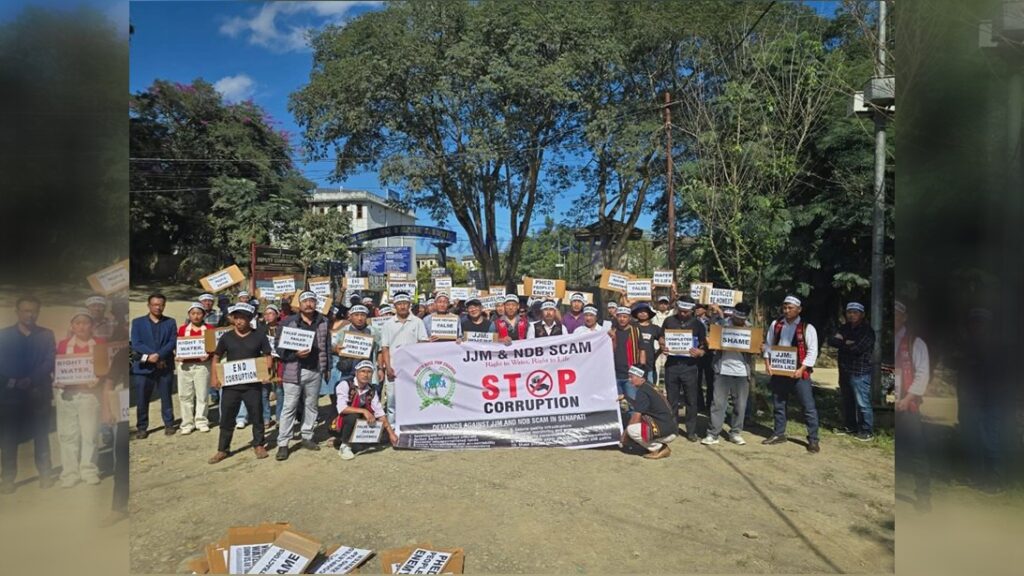
The recent decision of the Naga People’s Organization (NPO) to summon YR4C leader RK Paul Chawang on 17 November 2025 has sparked discussions across Senapati. The summon follows YR4C’s announcement of a dharna without prior approval, which the NPO claims violates its standing directive prohibiting bandhs, strikes and public gatherings unless cleared by the organisation.
The NPO has long maintained that such restrictions are essential to preserving peace and stability in the district. But the latest development must also be understood alongside the larger public frustration over persistent failures in the Jal Jeevan Mission (JJM).
The Heart of the Issue: Water Scarcity and Unfulfilled Promises
The dharna proposed by YR4C was not an act of disruption but an attempt to highlight one of Senapati’s most basic daily struggles.
Across numerous villages in the district:
JJM pipelines have not been installed,
Households still rely on public or village taps,
Families are forced to fetch water multiple times a day,
Children’s routines and school hours suffer, and
Livelihood activities are disrupted.
The Jal Jeevan Mission was meant to deliver functional household tap connections (FHTCs) and reduce this exact burden. Instead, the gap between paperwork and reality has widened, leaving many communities frustrated and unheard.
The dharna, therefore, was rooted in a legitimate public grievance — one that affects families every single day.
The NPO’s Position: Peace Through Regulation
The NPO’s directive banning unsanctioned protests is tied to its mandate of preserving harmony, especially in a district that values order and communal coordination.
Its latest summon is consistent with this approach.
However, peace imposed only through restriction risks overlooking the deeper issues that give rise to public expression in the first place. A community cannot be expected to remain silent when essential services like drinking water are absent.
The NPO’s role, therefore, cannot stop at regulation — it must extend to facilitating solutions.
A Moment for Constructive Dialogue
The summon presents an opportunity rather than a confrontation.
If approached constructively, the NPO–YR4C interaction could:
Clarify concerns on both sides,
Build mutual respect,
Strengthen community trust, and
Open channels for collective problem-solving.
Civil society organisations like YR4C are essential for accountability. Institutions like the NPO are essential for stability. When the two work together, the community benefits.
Accountability Is Integral to Peace
True peace is not merely the absence of protests — it is the presence of fairness, transparency and responsive governance.
Corruption or mismanagement in development schemes such as JJM doesn’t just hurt paperwork; it hurts people. When water doesn’t reach homes:
Women bear extra domestic burden,
Children lose study time,
Daily labourers lose productive hours,
Health risks increase.
These are real impacts that deserve real attention.
Supporting accountability is not anti-peace — it is essential for peace.
The Way Forward
If the NPO aligns its peacekeeping mandate with the public’s call for accountability, it can set the tone for a more united and responsive Senapati.
Key steps could include:
Facilitating a joint review of JJM implementation,
Ensuring village voices are heard,
Encouraging corruption-free project execution,
Supporting civic groups that highlight genuine issues,
Promoting peaceful, structured avenues for public grievances.
Senapati’s strength lies in its community institutions — when they collaborate rather than clash, progress becomes possible.