
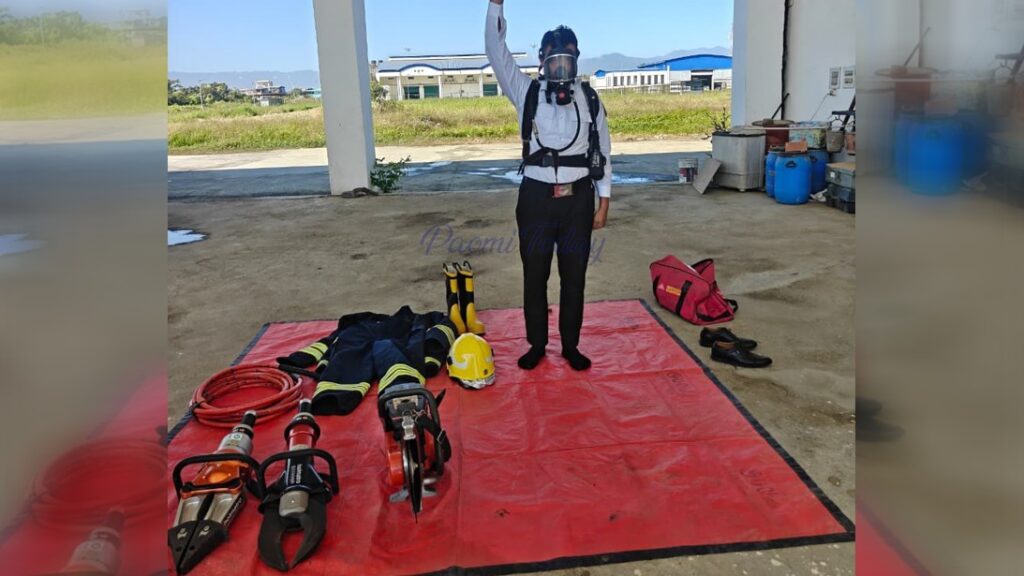
As part of the ongoing Aviation Safety Awareness Week, the Aircraft Rescue and Fire Fighting (ARFF) team carried out a comprehensive emergency preparedness drill and inspection of all fire-fighting systems at Imphal International Airport on Wednesday.
The exercise covered both live operational response and a complete technical audit of critical fire and emergency infrastructure across the airport. From fire extinguishers and hydrant networks to crash-tenders and automated emergency systems, every component was inspected for serviceability, response time and functional reliability.
Testing Real-Time Emergency Response
The drill simulated a high-risk aviation emergency requiring rapid deployment of ARFF units. Fire tenders were mobilised, communication channels were tested, and response coordination among ground staff was closely monitored. The aim was simple and uncompromising: ensure that in a real emergency, there is no delay, no confusion and no equipment failure.
Officials overseeing the drill said such exercises are not ceremonial activities but operational necessities. “Preparedness is built through routine stress-testing of systems and people. When an emergency happens, there is no time for learning,” one officer involved in the operation noted.
Equipment Inspection: No Detail Left Unchecked
Alongside the response drill, a full inspection was conducted on:
| Equipment / System | Status Checked |
|---|---|
| Portable Fire Extinguishers | Pressure, expiry, usability |
| Fire Hydrants & Hose Reels | Water flow, leakage, connectivity |
| Crash Tenders | Engine health, pump capacity, foam systems |
| Emergency Alarms & Sensors | Activation speed, signal accuracy |
| Backup Power Systems | Load capacity, instant switching |
Each unit was verified for operational readiness. Faults, if any, were noted for immediate rectification. The inspection ensures that every safety mechanism remains functional not just on paper, but in real-world emergency conditions.
Why Aviation Safety Week Matters
Aviation Safety Awareness Week is designed to reinforce a culture where safety is not treated as an occasional priority but as a daily responsibility. At airports, where thousands of lives pass through each day, even the smallest lapse can carry irreversible consequences.
Emergency fire and rescue services form the backbone of airport disaster response. Their readiness directly determines the outcome of worst-case scenarios — from aircraft fire incidents to fuel emergencies and terminal hazards.
By conducting this drill and inspection in a public, documented manner, the airport administration reaffirmed its commitment to protecting passengers, crew members, ground staff and infrastructure.
A Clear Message of Preparedness
What stood out during the exercise was the emphasis on coordination — not just equipment. Communication between control rooms, fire units, and operational staff was assessed in real time. Such drills help identify gaps that may not appear during routine daily operations.
The message from the exercise was unambiguous: safety is not optional. It is an everyday discipline. As air traffic continues to grow and operational demands increase, consistent emergency preparedness remains the most crucial safeguard in aviation operations.
With this drill, Imphal International Airport sent out a quiet but powerful assurance — that when seconds matter, the systems and the people behind them are ready.