
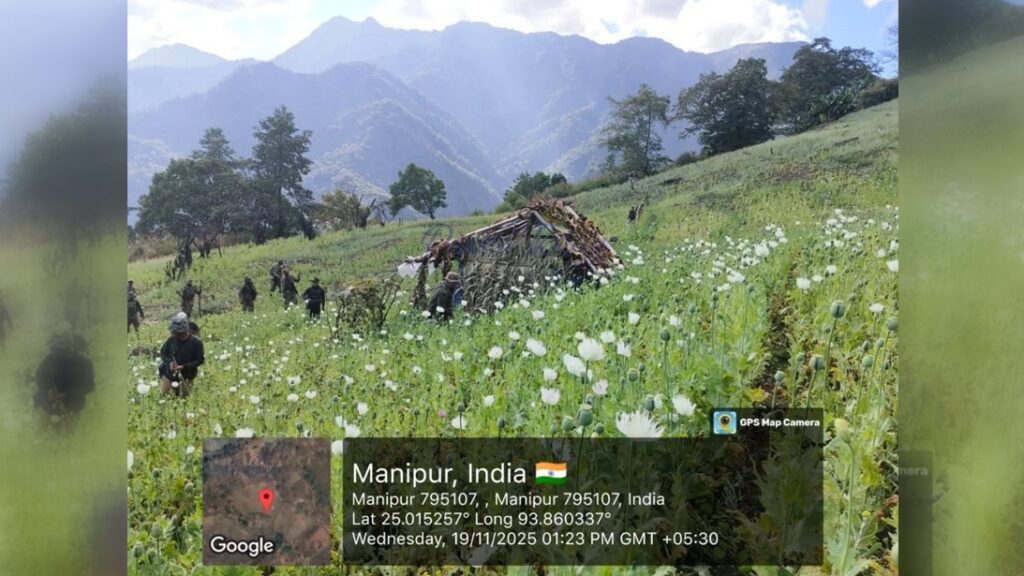
In one of the most significant anti-narcotics operations in recent weeks, Security Forces, in close coordination with the Forest Department and the Narcotics Control Bureau (NCB), destroyed over 109 acres of illegal poppy cultivation across the hill ranges of Senapati and Kangpokpi districts.
According to official sources, approximately six acres of poppy fields were destroyed at the hill range of Ngamju under Purul Police Station in Senapati district. In a separate and much larger operation, around 103 acres of poppy cultivation were eradicated at the hill ranges of Koubru and surrounding areas under Kangpokpi Police Station in Kangpokpi district.
Joint Force on the Ground
The coordinated drive involved multiple agencies working in tandem — the Security Forces, the Forest Department, and the Narcotics Control Bureau. Field teams navigated difficult hill terrain to reach remote plantation sites, many of which were deliberately established far from civilian habitation to avoid detection.
Officials said the plantations were systematically uprooted and destroyed on the spot to ensure they could not be revived or salvaged.
Massive Destruction of Infrastructure and Materials
Along with the standing poppy crops, enforcement teams dismantled and destroyed makeshift infrastructure and cultivation supplies found at the sites. The following items were recovered and destroyed:
| Seized / Destroyed Items | Quantity |
|---|---|
| Temporary huts | 30 |
| Fertilizer bags | 17 |
| Herbicide packets | 37 |
| Bags of salt | 13 |
| Cultivation tools & equipment | Multiple |
Authorities confirmed that these materials were being used to support large-scale, illegal cultivation in the hill areas. The presence of temporary huts indicates that cultivators had been staying at the sites for extended periods to guard and manage the crops.
Part of Sustained Anti-Narcotics Campaign
The latest operations form part of a wider and sustained campaign against illegal poppy cultivation in Manipur’s hill districts. Over the past years, poppy farming has emerged as a major driver of the narcotics supply chain in the region, fueling drug abuse, organized crime, and environmental degradation through forest destruction.
Security officials stated that such operations are not isolated actions but part of continuous surveillance, intelligence-based targeting, and follow-up destruction drives.
Ecological and Social Impact
Apart from its link to the drug trade, illegal poppy cultivation has also caused serious ecological damage. Large patches of forest land are routinely cleared to grow poppy, leading to soil erosion, loss of biodiversity, and water scarcity in downstream areas.
Local communities have repeatedly raised concerns over how poppy cultivation distorts traditional agriculture, weakens social structures, and draws youth into illegal networks.
Authorities Reaffirm Zero-Tolerance Stand
Officials involved in the operations reaffirmed that there will be zero tolerance toward illegal cultivation and that enforcement drives will continue across vulnerable hill ranges. Surveillance is being intensified to prevent re-plantation in the cleared zones.
The destruction of over 109 acres in just two operational zones sends a strong message — that coordinated enforcement remains one of the most critical tools to disrupt the narcotics supply chain at its source.