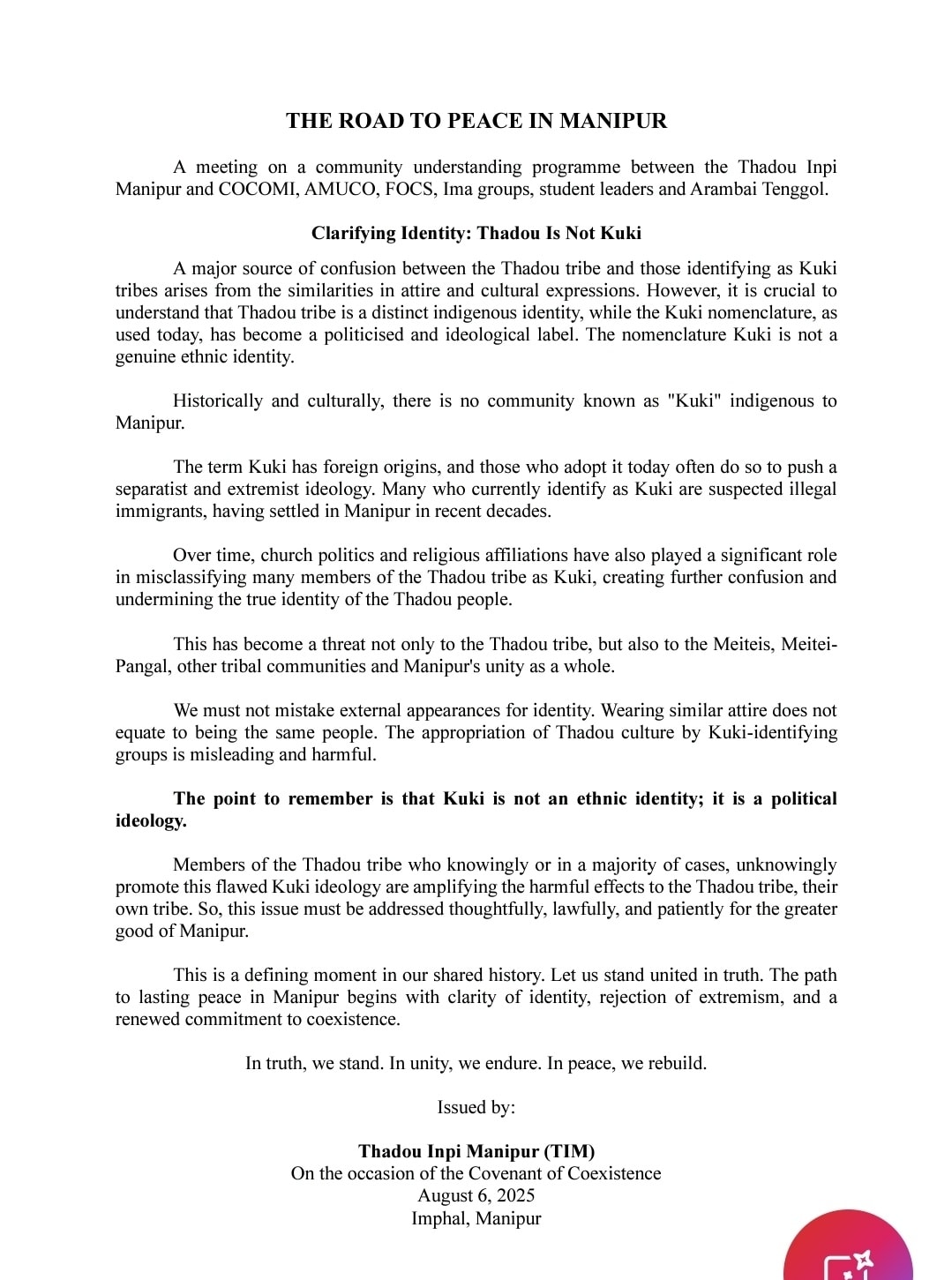
In a charged yet deliberate move toward peace, the Thadou Inpi Manipur (TIM) issued a clarion call for clarity over what they describe as a “politicised misclassification” of tribal identities in Manipur. The statement, made during a community understanding programme convened by TIM along with AMUCO, COCOMI, FOCS, student groups, and Arambai Tenggol, asserts that the term “Kuki” is a political ideology—not a legitimate ethnic identity.
The centrepiece of the address was titled “Clarifying Identity: Thadou Is Not Kuki,” and it left little room for ambiguity.
“The nomenclature ‘Kuki’ is not a genuine ethnic identity,” the statement reads. “It is a politicised label with foreign roots, often adopted to promote separatist ideology.”
Identity or Ideology?
At the heart of the issue lies a contested label: “Kuki.” According to TIM, many who currently identify as Kuki are not historically indigenous to Manipur but are rather recent immigrants who’ve adopted the identity for political ends.
The confusion, they argue, stems from overlapping attire and cultural expressions between the Thadou tribe and so-called Kuki-identifying groups. But TIM insists that visual similarities don’t equate to shared origins. The appropriation of Thadou culture, they warn, is not just misleading — it’s dangerous.
“Wearing similar attire does not make you the same people,” the statement clarifies.
Church Politics, Misinformation, and Cultural Loss
The document points to the influence of church politics and religious affiliations in distorting indigenous identities. Many Thadou, they claim, have been misclassified as Kuki either due to ignorance or religious-political influence — unintentionally furthering the ideological agenda.
This misrepresentation, they argue, undermines the true heritage of the Thadou tribe and sows discord across tribal communities — including Meiteis, Meitei-Pangal, and others.
A Call for Lawful Correction
The Thadou Inpi urges its community members to recognize the harm of adopting or promoting the Kuki label — whether knowingly or otherwise. They call for this issue to be addressed “thoughtfully, lawfully, and patiently.”
This comes at a time when Manipur has seen rising tension and violence rooted in ethnic identity and territorial claims. By framing the Kuki label as a political movement rather than a tribal identity, the TIM positions itself firmly against what it sees as a growing separatist narrative.
“The point to remember,” the document emphasizes, “is that Kuki is not an ethnic identity; it is a political ideology.”
Towards a Unified Peace
Ending on a note of cautious hope, the statement calls for unity grounded in truth.
“In truth, we stand. In unity, we endure. In peace, we rebuild.”
While the debate over identity in Manipur is far from over, this address marks a significant moment in the push for clarity — and, perhaps, for lasting peace.