
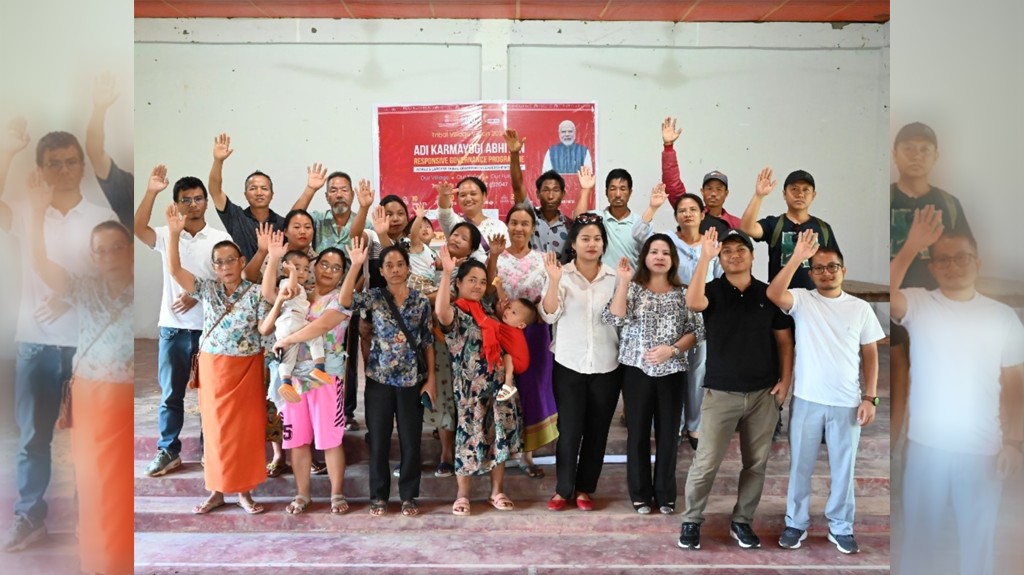
In a significant move toward grassroots empowerment and inclusive development, two tribal villages — Muallum and Sumchinvum under Singngat TD Block of Churachandpur District — have formally adopted their Village Vision 2030 and Village Action Plans (VAPs) under the Adi Karmayogi Abhiyan initiative.
The adoption marks a defining step in aligning local governance with the national vision of Viksit Bharat @2047 — empowering tribal communities to plan, act, and shape their own sustainable future through participatory decision-making.
Empowering Villages through Planning and Participation
The programme was conducted with active participation from village chiefs, elders, youth, and women’s groups, facilitated by officials of the District Administration Churachandpur and Singngat TD Block.
Villagers engaged in detailed community mapping exercises, identifying existing assets and gaps in infrastructure, health, education, and livelihoods. The participatory discussions resulted in the adoption of practical, community-led development priorities for the coming decade.
Among the key projects included in the Village Action Plans are:
| Development Priority | Proposed Initiative |
|---|---|
| Energy Access | Installation of solar street lights for safer public spaces |
| Water Supply | Construction and maintenance of gravity-fed pipelines and reservoirs |
| Connectivity | Upgradation of village approach roads and internal pathways |
| Health & Sanitation | Strengthening of primary health sub-centres and clean water systems |
| Community Infrastructure | Setting up village halls and youth resource centres |
Officials noted that these plans would now serve as the blueprint for integrated tribal development projects, with active coordination between state departments, local bodies, and central schemes.
Building the Vision: 2030 and Beyond
Under the Adi Karmayogi framework, the Village Vision 2030 is designed as a roadmap for self-reliant, sustainable, and future-ready tribal communities — linking local aspirations with national developmental goals.
“The idea is simple but powerful — development should start from the village, with the people,” said a district official overseeing the initiative.
“When communities create their own action plans, they take ownership. That’s how lasting change happens.”
The Adi Karmayogi Abhiyan, a part of the Ministry of Tribal Affairs’ ongoing rural transformation initiatives, aims to institutionalize bottom-up governance, emphasizing data-driven planning and inclusive participation.
People-Led, Locally Driven Development
At both Muallum and Sumchinvum, the event saw enthusiastic participation, with villagers contributing ideas and committing to take part in monitoring progress.
Women’s groups highlighted the need for safe water access and improved maternal healthcare, while youth representatives proposed skill training centres and sports facilities.
Community leaders expressed gratitude for the support and guidance received from the government, noting that the process had for the first time allowed the entire village to “sit together and decide its own priorities.”
“Earlier, we waited for projects to come. Now, we plan them ourselves — that’s empowerment,” said a village elder.
Towards a Self-Reliant Manipur
The initiative not only empowers communities but also reflects Manipur’s growing focus on integrated rural transformation and participatory planning at the grassroots level.
District officials confirmed that similar Village Vision 2030 and VAP adoption programmes are being rolled out across other tribal blocks in Kangpokpi, Tamenglong, and Ukhrul, ensuring no community is left behind in the march toward Viksit Bharat @2047.
As Manipur moves forward, initiatives like these reaffirm a collective promise — to build self-reliant, resilient, and developed villages that form the foundation of a stronger India.